
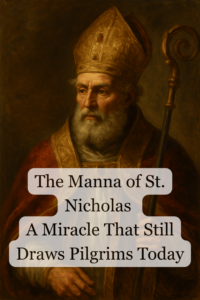
St. Nicholas is known around the world for his generosity, but there is an ancient tradition connected to him that many modern Catholics have never heard of—one that continues quietly, year after year, in a crypt on the Adriatic coast.
Welcome to Bari, Italy: home of the “manna of St. Nicholas.”
Who Was St. Nicholas?
Long before he inspired Christmas legends, St. Nicholas was the 4th-century Bishop of Myra, known for hidden acts of charity, fierce defense of the faith, and a heart tuned entirely to the needs of others. When Christians from Myra brought his relics to Bari in 1087 for safekeeping, devotion to the saint grew even stronger.
But something else came with them—something mysterious.
What Is the Manna of St. Nicholas?
For well over a thousand years, Christians have reported that a clear liquid forms near the relics of St. Nicholas. This “manna” (sometimes called myrrh) is collected annually on May 9, the feast of the translation of his relics.
Pilgrims travel from around the world to witness the ceremony, which takes place in the cool, candle-lit crypt beneath the Basilica di San Nicola.
The manna is believed to be a sign of St. Nicholas’s ongoing intercession and presence with the faithful. Historically, people used it for:
-
healing
-
protection
-
spiritual comfort
-
blessings for travelers and sailors
Even today, small vials of diluted manna are offered to pilgrims as a sacramental reminder of the saint’s generosity.
Miracle or Natural Phenomenon?
Back in 1925, researchers at the University of Bari ran chemical and microbiological tests on the manna of St. Nicholas. Here’s what they found:
✨ 1. The manna is NOT the same as rainwater or seawater.
External water around the basilica tested cloudy, dirty, and full of residue.
The manna? Almost completely pure.
✨ 2. The chemical tests showed the manna is “almost pure water.”
Both samples (from 1910 and 1925) had extremely low mineral residue—far lower than normal groundwater.
In fact, scientists remarked that water this pure is rare, except in special natural environments like glacial melt.
✨ 3. The manna doesn’t appear contaminated or polluted.
The bacteriology tests found:
-
very few microbes
-
no coliform bacteria
-
purity levels that rule out surface contamination
And remember: the relic chamber stays sealed except during the annual collection.
✨ 4. The scientists concluded the manna forms in conditions that exclude outside water.
Their official report stated that its purity and characteristics do not match the infiltration water around the basilica.
✨ 5. Translation:
Whatever the manna is…
it doesn’t act like normal water, it doesn’t come from outside, and its purity is unusual even by scientific standards.
The Church doesn’t declare it “miraculous,” but it does treat it as a relic, because the water forms in contact with the bones of St. Nicholas. And countless pilgrims have reported consolation through it for centuries.
Visiting the Relics Today
The Basilica di San Nicola in Bari is one of the most atmospheric pilgrimage sites in Europe. Pilgrims can:
-
pray at the saint’s tomb
-
attend the annual manna ceremony
-
venerate the relics
-
explore the medieval basilica built in his honor
Bari is also a beautiful coastal city—sunlight, sea breeze, fresh seafood, and a deeply Catholic heritage.
A smaller portion of St. Nicholas’s relics can also be found in Venice, at the Church of St. Nicholas on Lido Island.
Why This Matters for Families
St. Nicholas isn’t just a holiday icon—he is a model of generous, hidden holiness. Taking children or grandchildren to his resting place connects them with:
-
the real story behind Santa Claus
-
a saint who loved families
-
a miracle still unfolding in our time
-
the beauty of Catholic tradition
It’s the kind of experience that becomes a memory anchor for life.
Final Reflection
The manna of St. Nicholas reminds us that God often speaks through the quiet, surprising, and unexplainable. Whether you see it as miracle or mystery, it invites us to slow down, lean in, and believe that holiness leaves traces we can still touch.
If visiting the relics of St. Nicholas is on your heart—or if you’d love a family PRAYcation™ that blends wonder, beauty, and faith—I’d be honored to help you design it. Fill out my travel interest form at the link above or just sign up for a complimentary consultation!
Join my free community for Catholic families and fellow faithful travelers:
Catholic Family Pilgrimages and PRAYcations™
